It has been a couple of years since I last commented about e-cigarettes. I'm not sure my position has changed drastically. To recap, I have stated they needed to be investigated thoroughly for safety and if they're to be sold as smoking cessation aids, then there should be studies to show their effectiveness, that is, double-blinded, controlled studies; not anecdotal reports with numerous study-related flaws. There are a few studies in the pipeline, so we should have some unbiased information soon.
Are they the lesser of two evils? Is smoking a tobacco cigarette safer than vaporizing and inhaling a bunch of chemicals? Probably...maybe, but who knows for sure since there are no studies detailing their safety profile. I have stated that e-cigarettes do have promise, especially as social acceptance of these devices gain momentum. I just wish there was more transparency from the manufacturers. Not that I feel that coming under the FDA would fix all the problems. I know the FDA is far from a faultless or error free organization. But as a general rule, they do good work and protect the consumer from more then we're willing to admit, in spite of any political allegiances their leadership may declare.
I'm not ready to close the book on e-cigarettes but I'm also not ready to throw them out with the bath water. I'm maintaining my wait and see approach until the scientific community can catch up.
Sunday School and Smoking
I was surprised to hear my 8 year old report how she learned how bad smoking was in her Sunday school at church. She had one of those rubber bracelets with the word "toxic" emblazoned upon it. She then went on to tell me how nicotine was bad and how there were these things called "carcinogens" in tobacco. She couldn't remember how to pronounce carcinogen, but I knew what she was talking about.
I thought it a little off topic for a Christian Sunday School, but then I figured why not talk about it there. Every bit of reinforcement I can have from trusted sources, I'll welcome. You see, I don't want my kids smoking, in this world or the one to come - pun intended;)
So anyway, just thought I'd share that revelation with you.
I thought it a little off topic for a Christian Sunday School, but then I figured why not talk about it there. Every bit of reinforcement I can have from trusted sources, I'll welcome. You see, I don't want my kids smoking, in this world or the one to come - pun intended;)
So anyway, just thought I'd share that revelation with you.

NicVax - A Nicotine Vaccine
There has been growing excitement over the development of a nicotine vaccine. It has been viewed by some in the smoking cessation community as the "magic bullet" for smokers wanting to quit easily. Just get a shot and poof, stop smoking. This enthusiasm hit a road block in 2011, as clinical stage III trials reported that NicVax did not have any benefit over placebo. Bummer.
Now there is a new promise as another study points to the abstinence rates for those with a high blood serum level of NicVax. This study reports a higher 8 week continuous abstinence rate from weeks 19 to 26. To get the high serum level, participants received 5 injections of 400 micrograms of NicVax over a 6 month period. The abstinence rates were statistically significant.
The researchers say, and I'll paraphrase, "This study demonstrates, as proof of concept, that NicVax is associated with higher continuous abstinence rates (CAR). Its further development as a treatment for nicotine dependence is therefore justified."
So there is hope yet for the makers of NicVax and their shareholders. Perhaps it is just a dosing issue or perhaps it only helps you after you've stopped smoking for 5 months, who knows. But one thing is for sure, more studying is required.
Now there is a new promise as another study points to the abstinence rates for those with a high blood serum level of NicVax. This study reports a higher 8 week continuous abstinence rate from weeks 19 to 26. To get the high serum level, participants received 5 injections of 400 micrograms of NicVax over a 6 month period. The abstinence rates were statistically significant.
The researchers say, and I'll paraphrase, "This study demonstrates, as proof of concept, that NicVax is associated with higher continuous abstinence rates (CAR). Its further development as a treatment for nicotine dependence is therefore justified."
So there is hope yet for the makers of NicVax and their shareholders. Perhaps it is just a dosing issue or perhaps it only helps you after you've stopped smoking for 5 months, who knows. But one thing is for sure, more studying is required.
Do Smokers Have Higher Lifetime Medical Costs
The title of this article really caught my eye: "Lifetime medical expenditures of smokers and nonsmokers". So the question is this, do smokers spend more money on medical costs in their lifetime than non-smokers? I think that's a great question. But it's also one of those leading questions where we all think we know the answer.
So lets think about this for a second. Smokers do have a higher prevalence for disease. And not just any disease, but the big, devastating, heavy-hitters like stroke, cancer, COPD, etc. Those are fairly expensive to treat without a doubt. Plus, they have multiple admissions to hospitals and treatment centers.
But I know nonsmokers who also have strokes, cancer and heart disease. They spend a lot of money for treating those disease as well.
Hum...this is a tougher question that I previously thought. Well the researchers in Japan just happen to have a ton of data to evaluate this question objectively. Here is what they found. Their results showed that it is true, smokers did have overall higher annual medical expenditures than nonsmokers - but the smokers lifetime costs were actually slightly lower than nonsmokers. Well, how can this be?
When you look at the results a little more, you see the catch. The reason why smokers had lower cumulative lifetime medical costs is because they didn't live as long as nonsmokers. So yes, they are being devastated by diseases. They are spending tons of money in healthcare costs. They're just doing it with a smaller lifespan. This shorter life expectancy, due to the high mortality rate associated with smoking, gave them the lower medical expenditures.
So the moral of the story...a) "smoke and spend less money at the hospital" or b) "stop smoking and take better care of yourself so you will enjoy a longer more fruitful life". I don't know about you, but I'll take (b) as the right answer.
If we could just get people to stop asking the silly question, " is nicotine bad for you". It's obvious that nicotine by itself is not directly bad for you, but the result of a lifetime addicted to nicotine does have disasterous physiological and financial effects.
So lets think about this for a second. Smokers do have a higher prevalence for disease. And not just any disease, but the big, devastating, heavy-hitters like stroke, cancer, COPD, etc. Those are fairly expensive to treat without a doubt. Plus, they have multiple admissions to hospitals and treatment centers.
But I know nonsmokers who also have strokes, cancer and heart disease. They spend a lot of money for treating those disease as well.
Hum...this is a tougher question that I previously thought. Well the researchers in Japan just happen to have a ton of data to evaluate this question objectively. Here is what they found. Their results showed that it is true, smokers did have overall higher annual medical expenditures than nonsmokers - but the smokers lifetime costs were actually slightly lower than nonsmokers. Well, how can this be?
When you look at the results a little more, you see the catch. The reason why smokers had lower cumulative lifetime medical costs is because they didn't live as long as nonsmokers. So yes, they are being devastated by diseases. They are spending tons of money in healthcare costs. They're just doing it with a smaller lifespan. This shorter life expectancy, due to the high mortality rate associated with smoking, gave them the lower medical expenditures.
So the moral of the story...a) "smoke and spend less money at the hospital" or b) "stop smoking and take better care of yourself so you will enjoy a longer more fruitful life". I don't know about you, but I'll take (b) as the right answer.
If we could just get people to stop asking the silly question, " is nicotine bad for you". It's obvious that nicotine by itself is not directly bad for you, but the result of a lifetime addicted to nicotine does have disasterous physiological and financial effects.
Home Smoking Bans
I never really thought about this subject until a recent journal article prompted me toward evaluation. The question is, "Do you have a smoking ban at home?" Well, if both parents are nonsmokers, the answer seems pretty obvious, yes. But what about children who smoke in a household where the parents don't? Do the parents maintain the ban or give into the whim of the child. Perhaps they place rules on smoking like 'only do it outside'.
I think nonsmoking parents are in a great position to legislate the household toward a smoking ban. Not because you want to keep your kid from getting nicotine poisoning or anything. But after all, it is the parent's house. They make the payments and the kid just kind of lives there rent free. It seems like the parents could really make a stand on this issue. In the long run, they'd be improving the health of their kids and themselves by limiting the amount of direct and indirect smoke inhaled by the family. A win-win for everyone, whether they realize it at the time or not.
Who knows, perhaps the kid will quit as the cycle of addiction gets interrupted in the house. Then they can see what happens when you quit smoking.
I think nonsmoking parents are in a great position to legislate the household toward a smoking ban. Not because you want to keep your kid from getting nicotine poisoning or anything. But after all, it is the parent's house. They make the payments and the kid just kind of lives there rent free. It seems like the parents could really make a stand on this issue. In the long run, they'd be improving the health of their kids and themselves by limiting the amount of direct and indirect smoke inhaled by the family. A win-win for everyone, whether they realize it at the time or not.
Who knows, perhaps the kid will quit as the cycle of addiction gets interrupted in the house. Then they can see what happens when you quit smoking.
Smoking, Brain Injury and Varenicline Side Effects
We like to evaluate the science behind tobacco control, smoking cessation and smoking related diseases here at Unbiased. Every once in a while we come across an article that just makes us say, "Really?"
This was our response to the recent article found in Cognitive and Behavioral Neurology. It sounds like a great scientific journal doesn't it? But then you read something like this article and it makes you scratch your head.
So the title is "Smoking Cessation After Brain Damage Does Not Lead to Increased Depression: Implications for Understanding the Psychiatric Complications of Varenicline". Very long and full of promise that some wonderful revelation is forthcoming.
Here's what they said. The process of quitting smoking in patients with brain lesions, didn't lead to higher levels of depression. Okay, that's not so bad. I suppose that is good information to have. Somebody bumps their head and decides to quit smoking; depression isn't that big of a player. But then they continue with a tremendous leap of faith. They go on to "suggest" that because of this lack of increased depression, that psychiatric complications linked with the use of varenicline (Chantix) are not related to the process of smoking cessation, but are solely brought on by the drug iteself.
Wow, what a conclusion; especially given the fact that 1) varenicline was not a component of the study and 2) only 70 patients were studied, all with brain lesions.
So even though they did not study the use of varenicline in the study, they were able to conclude that all the psychiatric side effects (primarily depression) reported with a drug are related to the drug. They conclude this because the 32 quitters in the study group, had the same same depressive profile as those who did not quit. If you ask me, it sounds like brain lesions may keep depression at bay when trying to quit smoking.
I know, that is just as ridiculous of a conclusion as they came to. But it just goes to show, that not all science is good science. Not all conclusions are fair and just conclusions. The study group is too small and the variables are not set in a way to make any conclusive or suggestive statements about varenicline.
Until next time, remember to read these articles with a critical eye.
This was our response to the recent article found in Cognitive and Behavioral Neurology. It sounds like a great scientific journal doesn't it? But then you read something like this article and it makes you scratch your head.
So the title is "Smoking Cessation After Brain Damage Does Not Lead to Increased Depression: Implications for Understanding the Psychiatric Complications of Varenicline". Very long and full of promise that some wonderful revelation is forthcoming.
Here's what they said. The process of quitting smoking in patients with brain lesions, didn't lead to higher levels of depression. Okay, that's not so bad. I suppose that is good information to have. Somebody bumps their head and decides to quit smoking; depression isn't that big of a player. But then they continue with a tremendous leap of faith. They go on to "suggest" that because of this lack of increased depression, that psychiatric complications linked with the use of varenicline (Chantix) are not related to the process of smoking cessation, but are solely brought on by the drug iteself.
Wow, what a conclusion; especially given the fact that 1) varenicline was not a component of the study and 2) only 70 patients were studied, all with brain lesions.
So even though they did not study the use of varenicline in the study, they were able to conclude that all the psychiatric side effects (primarily depression) reported with a drug are related to the drug. They conclude this because the 32 quitters in the study group, had the same same depressive profile as those who did not quit. If you ask me, it sounds like brain lesions may keep depression at bay when trying to quit smoking.
I know, that is just as ridiculous of a conclusion as they came to. But it just goes to show, that not all science is good science. Not all conclusions are fair and just conclusions. The study group is too small and the variables are not set in a way to make any conclusive or suggestive statements about varenicline.
Until next time, remember to read these articles with a critical eye.
COPD and Smoking Cessation Options
The primary cause of chronic obstructive pulmonary disease or COPD is smoking tobacco. Studies continue to show that people who suffer from COPD have a much more difficult time with smoking cessation. Smoking cessation is the only real way of slowing down the progression of the disease. The sooner someone stops smoking, the slower their disease will progress.
A recent study out of Nicotine and Tobacco Research looked at the ability of certain front line smoking cessation aids to meet with this COPD challenge. The primary outcome measured was continuous abstinence rates from 9 - 24 weeks, or between 2 and 6 months of smoking cessation. They found that severe and very severe COPD patients were primarily male. Interestingly, this large subgroup of the study population had a very high physical addiction to nicotine.
The results show a continuous abstinence rate between weeks 9-24 to be 48.5%. So just slightly less than half were able to stay nicotine free between the study period of 9-24 weeks. The abstinence rate differed according to type of stop smoking aid utilized.
Nicotine replacement therapy (NRT) had a 38.2% cessation rate. It also had the fewest recorded side effects. However, the dreaded psychiatric symptoms sometimes reported were rare in all stop smoking methods studied and evenly distributed across all groups. Bupropion (Zyban) had a quit rate of 55.6%, while varenicline (Chantix) had the highest cessation rate of 58.3%.
This study only points out the difficulty associated with smoking cessation in someone who is afflicted with a multi-dimensional disease like COPD. This disease carries with it many other complicatiang diseases which affect the physical, emotional and psychiatric status of the sufferer. It is no surprise that something more than simple nicotine replacement was needed to help these people break the cycle of nicotine dependence.
People often ask, " is nicotine bad for you?" I think the answer is pretty evident. The dependence creates a continuous assault on the health of your body. Then you suddenly wake up 30-40 years later with a disease, or more than likely, a mix of diseases, that affects everything from how you breathe, to how far you can walk each day.
According to this study though, it's not too late. You can still quit, despite your disease status. So get some help and do the right thing, for yourself and for your family.
A recent study out of Nicotine and Tobacco Research looked at the ability of certain front line smoking cessation aids to meet with this COPD challenge. The primary outcome measured was continuous abstinence rates from 9 - 24 weeks, or between 2 and 6 months of smoking cessation. They found that severe and very severe COPD patients were primarily male. Interestingly, this large subgroup of the study population had a very high physical addiction to nicotine.
The results show a continuous abstinence rate between weeks 9-24 to be 48.5%. So just slightly less than half were able to stay nicotine free between the study period of 9-24 weeks. The abstinence rate differed according to type of stop smoking aid utilized.
Nicotine replacement therapy (NRT) had a 38.2% cessation rate. It also had the fewest recorded side effects. However, the dreaded psychiatric symptoms sometimes reported were rare in all stop smoking methods studied and evenly distributed across all groups. Bupropion (Zyban) had a quit rate of 55.6%, while varenicline (Chantix) had the highest cessation rate of 58.3%.
This study only points out the difficulty associated with smoking cessation in someone who is afflicted with a multi-dimensional disease like COPD. This disease carries with it many other complicatiang diseases which affect the physical, emotional and psychiatric status of the sufferer. It is no surprise that something more than simple nicotine replacement was needed to help these people break the cycle of nicotine dependence.
People often ask, " is nicotine bad for you?" I think the answer is pretty evident. The dependence creates a continuous assault on the health of your body. Then you suddenly wake up 30-40 years later with a disease, or more than likely, a mix of diseases, that affects everything from how you breathe, to how far you can walk each day.
According to this study though, it's not too late. You can still quit, despite your disease status. So get some help and do the right thing, for yourself and for your family.
Smoking Cessation, Lapsing and Relapsing
Smoking cessation is the act of no longer smoking. However, this state may last one day or it can last a lifetime. Lapsing is when you have 1 or more cigarettes during a quit or cessation attempt. Relapse occurs when you are no longer trying to actively quit and have returned to a regular habitual smoking routine.
So the question is this, can you get back on the wagon after you've fallen off? Can the quit attempt remain in place even though you had a 'bad day' and smoked half a pack of cigarettes? The answer is absolutely 'yes'! That's why it is important to review the definitions above. Lapsing does not have to lead to relapsing.
A recent study in the journal Addiction, looked at this phenomena and how to treat the lapse before it became a full blown relapse. Interestingly, they looked to the good old nicotine patch to see if it could promote recovery to abstinence.
As we all know, one of the effects of nicotine withdrawal is the craving. Nicotine patches were designed to counteract that craving with a dose of nicotine replacement to the brain using a far more clinical platform.
What happens when you relapse? You smoke for a day or two; you feel like a failure; you throw your hands up, put away your stop smoking aids and figure you've completely relapsed. This 'give-up' is one reason why smoking has such a high rate of recidivism. But it is possible to climb back up on that horse and start riding again without waiting two or three months.
The researchers discovered that using the patch increased the tendency to re-initiate abstinence at the critical 6 and 10 week interval, after lapsing. They conclude that continuing treatment with active patches does promote recovery from lapses and helps smokers regain their cessation 'mo-jo'. Let's face it, when you're trying to quit, you've got to have mo-jo and it looks like patches might be able to help you find it after a lapse.
So the question is this, can you get back on the wagon after you've fallen off? Can the quit attempt remain in place even though you had a 'bad day' and smoked half a pack of cigarettes? The answer is absolutely 'yes'! That's why it is important to review the definitions above. Lapsing does not have to lead to relapsing.
A recent study in the journal Addiction, looked at this phenomena and how to treat the lapse before it became a full blown relapse. Interestingly, they looked to the good old nicotine patch to see if it could promote recovery to abstinence.
As we all know, one of the effects of nicotine withdrawal is the craving. Nicotine patches were designed to counteract that craving with a dose of nicotine replacement to the brain using a far more clinical platform.
What happens when you relapse? You smoke for a day or two; you feel like a failure; you throw your hands up, put away your stop smoking aids and figure you've completely relapsed. This 'give-up' is one reason why smoking has such a high rate of recidivism. But it is possible to climb back up on that horse and start riding again without waiting two or three months.
The researchers discovered that using the patch increased the tendency to re-initiate abstinence at the critical 6 and 10 week interval, after lapsing. They conclude that continuing treatment with active patches does promote recovery from lapses and helps smokers regain their cessation 'mo-jo'. Let's face it, when you're trying to quit, you've got to have mo-jo and it looks like patches might be able to help you find it after a lapse.
Smoking in People With ADHD
We know that segments of the population with lower education and lower socio-economic resources are at a higher risk for developing smoking dependence. The authors in a new study in the Journal of Attention Disorders wanted to see if there was any relationship between ADHD and nicotine dependence.
First of all, what is nicotine dependence? There is a pretty good clinical definition out there, but basically it boils down to whether you find yourself needing a smoke. If you feel this way then chances are, you have nicotine dependence. Nicotine is a very addictive drug in tobacco which creates a contentment in the brain by releasing a specific neurotransmitter, dopamine. People who have a high nicotine dependence typically crave this feeling.
It should be no surprise then, as we read how the researchers discovered a very strong link between ADHD and nicotine dependence in adulthood. They point out the lack of research in ADHD adults who smoke. The results of their study show a higher rate of smokers in the ADHD study group. This is no real surprise and has been shown before in the literature. But they also found that adult smokers with the ADHD diagnosis had a more severe nicotine dependence and smoked at a significantly more higher frequency when sick. Smoking when sick is an indication of strong nicotine dependence/addiction. ADHD women smoked significantly more frequently and initiated smoking at a younger age.
So what does this tell us? Well, it says that people with ADHD tend to smoke more frequently than other parts of the population. It also states that their nicotine dependence is much higher, especially in women, than in the traditional smoking population.
This is important to note as it may help direct treatment strategies for those who suffer from ADHD.
First of all, what is nicotine dependence? There is a pretty good clinical definition out there, but basically it boils down to whether you find yourself needing a smoke. If you feel this way then chances are, you have nicotine dependence. Nicotine is a very addictive drug in tobacco which creates a contentment in the brain by releasing a specific neurotransmitter, dopamine. People who have a high nicotine dependence typically crave this feeling.
It should be no surprise then, as we read how the researchers discovered a very strong link between ADHD and nicotine dependence in adulthood. They point out the lack of research in ADHD adults who smoke. The results of their study show a higher rate of smokers in the ADHD study group. This is no real surprise and has been shown before in the literature. But they also found that adult smokers with the ADHD diagnosis had a more severe nicotine dependence and smoked at a significantly more higher frequency when sick. Smoking when sick is an indication of strong nicotine dependence/addiction. ADHD women smoked significantly more frequently and initiated smoking at a younger age.
So what does this tell us? Well, it says that people with ADHD tend to smoke more frequently than other parts of the population. It also states that their nicotine dependence is much higher, especially in women, than in the traditional smoking population.
This is important to note as it may help direct treatment strategies for those who suffer from ADHD.
Cost of Varenicline Versus Bupropion
So you've decided to quit but you're kind of a tight-wad and don't want to spend too much money to do it. You've heard some stop smoking aids are cheaper than others, but nothing can compare with quittig cold turkey which is...well, 'free'. What to do?
Well, a recent study published in the journal Int J Clin Pract tells us which prescription stop smoking aid is more cost effective. They evaluated many articles and ran them through cost models. They make a point of noting that price and access will change how much you actually pay, but in general terms, there was a clear winner. So which was it, Varenicline or Bupropion?
Before we answer that question there are a couple things I'd like to point out.
The obvious one is that you shouldn't be a tight-wad when you are quitting smoking. I have a blog post in here that talks about the real cost of smoking. It's a pretty good read, if I do say so myself. Anyway, if a smoker is spending up to $10-15 per pack per day, then you can't be a tight-wad. Man, you are a free spender throwing around that kind of dough each day. Not to mention the cost of doctor's appointments and long term care for when you develop one of those nasty smoking related illnesses. But I digress. So don't let the cost be a stumbling block for you quitting.
Second, you shouldn't choose the stop smoking aid or quitting method based on cost. It needs to be tailored based on your nicotine addiction, smoking triggers, behavior, side-effects, etc. Certainly cost can be a consideration, but it shouldn't be the only consideration.
Okay then, which method won. Varenicline! As a reminder, the researchers did not look at the nicotine replacement therapies or the other non-first line therapies like hypnosis. They just looked at varenicline and bupropion. So there you go, you asked and now you know.
Well, a recent study published in the journal Int J Clin Pract tells us which prescription stop smoking aid is more cost effective. They evaluated many articles and ran them through cost models. They make a point of noting that price and access will change how much you actually pay, but in general terms, there was a clear winner. So which was it, Varenicline or Bupropion?
Before we answer that question there are a couple things I'd like to point out.
The obvious one is that you shouldn't be a tight-wad when you are quitting smoking. I have a blog post in here that talks about the real cost of smoking. It's a pretty good read, if I do say so myself. Anyway, if a smoker is spending up to $10-15 per pack per day, then you can't be a tight-wad. Man, you are a free spender throwing around that kind of dough each day. Not to mention the cost of doctor's appointments and long term care for when you develop one of those nasty smoking related illnesses. But I digress. So don't let the cost be a stumbling block for you quitting.
Second, you shouldn't choose the stop smoking aid or quitting method based on cost. It needs to be tailored based on your nicotine addiction, smoking triggers, behavior, side-effects, etc. Certainly cost can be a consideration, but it shouldn't be the only consideration.
Okay then, which method won. Varenicline! As a reminder, the researchers did not look at the nicotine replacement therapies or the other non-first line therapies like hypnosis. They just looked at varenicline and bupropion. So there you go, you asked and now you know.
Can You Believe Self-Reporting of Smoking Activity
I remember when my healthcare facility became a non-smoking institution. Strange to say it now, but there was a time when patients could smoke in their hospital rooms. Older staff members still tell stories of cardio-thoracic surgeons finishing a cigarette outside the patient's room prior to going in. How weird that must have been to be a patient back then and smell cigarette smoke on your doctor or see it in the hallways as you walked with your IV pole to the nurse's station.
Well, nowadays, most hospitals are smoke-free, as are many other organizations and companies. Smoking bans have become a very popular strategy for companies who want to position themselves in a positive light within their community, and more importantly, their health insurance benefit providers. Less smoking means less risk assumed by the insurance company. Less risk means lower premiums. That is good for both the employee and employer.
I see published reports which state that company X reports a 95% compliance with their smoking ban, while company Y reports a 92% compliance. I always wondered if those were very accurate. I mean, after all, everybody wants high compliance so the premiums will stay down. The skeptic in me assumes the compliance rate is probably just over half of the reported, maybe two-thirds, but come on, 90+% compliance rates? No way. I'll eat my hat if those self-reporting rates are close to being realistic.
Well, pass the salt. A new study actually confirms that smoking ban compliance self-reporting is pretty dog-gone accurate. I didn't believe it either, but there it was in black and white. Now they did mention the self-reporting is slightly inflated over actual observed compliance, but not by much.
The authors go on to say that self-reporting is an excellent way to gauge compliance and should be used more frequently. This would alleviate the man hours spent in tier I or II "observation" of employees and make it much more inexpensive to monitor such activities. Hey, everybody wins when the employer saves money.
Well, nowadays, most hospitals are smoke-free, as are many other organizations and companies. Smoking bans have become a very popular strategy for companies who want to position themselves in a positive light within their community, and more importantly, their health insurance benefit providers. Less smoking means less risk assumed by the insurance company. Less risk means lower premiums. That is good for both the employee and employer.
I see published reports which state that company X reports a 95% compliance with their smoking ban, while company Y reports a 92% compliance. I always wondered if those were very accurate. I mean, after all, everybody wants high compliance so the premiums will stay down. The skeptic in me assumes the compliance rate is probably just over half of the reported, maybe two-thirds, but come on, 90+% compliance rates? No way. I'll eat my hat if those self-reporting rates are close to being realistic.
Well, pass the salt. A new study actually confirms that smoking ban compliance self-reporting is pretty dog-gone accurate. I didn't believe it either, but there it was in black and white. Now they did mention the self-reporting is slightly inflated over actual observed compliance, but not by much.
The authors go on to say that self-reporting is an excellent way to gauge compliance and should be used more frequently. This would alleviate the man hours spent in tier I or II "observation" of employees and make it much more inexpensive to monitor such activities. Hey, everybody wins when the employer saves money.
Academic Achievement and Smoking Initiation
This particular topic has been studied before and even commented on by me. But it bears repeating, especially when a great study comes out and tells us something we all suspected in the first place. The question is this, if people who have greater college education smoke less, then how far back can we trace this phenomona? In other words, do lower achievers in say, high school, middle school or even elementary school, have a greater propensity to end up a smoker?
I love the journal Addiction. They publish some really unique studies on nicotine addiction. The researchers here have really hit a home run, or at least I think so. They evaluated 741 kids with absolutely no history of smoking in the 7th grade, this is in Canada. They followed these kids for 4 years up through grade 10. Here's what they found.
Based on the grade point average (GPA) of the students, three academic achievement levels or what they call trajectories were identified: high achievers (HA), average achievers (AA) and unstable low achievers (ULA). ULA made up about 12% of the total studied population. Within these three groups were identified different rates of smoking initiation.
HA - 7.1% initiation
AA - 15.1% initiation
ULA - 49.1% initiation
Lets see if we can identify a trend. Hum, it's on the tip of my tongue. Pretty startling isn't it. In addition, they found that ULA students who had involved and educated parents were less likely to initiate smoking.
It looks as if apathy is the largest contributor to smoking initiation. Here comes my sweeping, broad stroked statement - kids who aren't taught to care about their education by their parents seem doomed to repeat their parents' mistakes. Now granted, some of these kids have very difficult family situations, but I'm sure those exist in all the populations studied.
The point is this, education seems to matter, especially when it comes to smoking. The less educated smoke more. Those identified early in adolescence as low achievers will end up smoking more. This is great to know because that means we can intervene in this time of their life and potentially break the cycle of addiction before it starts. Nicotine and the brain do not mix, especially at such a young age. But it seems we can do something about it. So talk to your kids before he/she gets to 7th grade about how smoking is stupid and how it kills people. We do it here all the time and my kids are totally grossed out by smoking and think it's the worst thing ever.
I love the journal Addiction. They publish some really unique studies on nicotine addiction. The researchers here have really hit a home run, or at least I think so. They evaluated 741 kids with absolutely no history of smoking in the 7th grade, this is in Canada. They followed these kids for 4 years up through grade 10. Here's what they found.
Based on the grade point average (GPA) of the students, three academic achievement levels or what they call trajectories were identified: high achievers (HA), average achievers (AA) and unstable low achievers (ULA). ULA made up about 12% of the total studied population. Within these three groups were identified different rates of smoking initiation.
HA - 7.1% initiation
AA - 15.1% initiation
ULA - 49.1% initiation
Lets see if we can identify a trend. Hum, it's on the tip of my tongue. Pretty startling isn't it. In addition, they found that ULA students who had involved and educated parents were less likely to initiate smoking.
It looks as if apathy is the largest contributor to smoking initiation. Here comes my sweeping, broad stroked statement - kids who aren't taught to care about their education by their parents seem doomed to repeat their parents' mistakes. Now granted, some of these kids have very difficult family situations, but I'm sure those exist in all the populations studied.
The point is this, education seems to matter, especially when it comes to smoking. The less educated smoke more. Those identified early in adolescence as low achievers will end up smoking more. This is great to know because that means we can intervene in this time of their life and potentially break the cycle of addiction before it starts. Nicotine and the brain do not mix, especially at such a young age. But it seems we can do something about it. So talk to your kids before he/she gets to 7th grade about how smoking is stupid and how it kills people. We do it here all the time and my kids are totally grossed out by smoking and think it's the worst thing ever.
Is Nicotine Bad
I was searching on the internet the other day and came across this question that someone asked, "is nicotine bad for you". I thought about this for a while and didn't really know how to answer the question because I thought the wrong question was being asked. Seriously, should we be asking if nicotine is bad when there are a host of other cancer causing agents in tobacco. I mean, is someone going to quit smoking because the idea of smoking causing lung cancer just isn't scary enough, they also need to know that nicotine makes your ears ring before they'll quit.
I talk a little more about this question on my website. But I just wanted to drop in for a second and publish this thought before I forgot about it.
I talk a little more about this question on my website. But I just wanted to drop in for a second and publish this thought before I forgot about it.
Nicotine Replacement Therapy as a Quitting Tool
Nicotine replacement therapy (NRT) has been around a long time, with varying degrees of success. Most agree that NRT will double a person's chance of quitting over going cold turkey alone. But the outcomes, defined as smoking cessation, are still pretty small.
A recent study looked at the affect NRT had on smoking reduction and temporary abstinence in England. The researchers wanted to see if NRT use could predict smoking cessation attempts. I'm not really sure why they were asking this question and the end result of the study is not what I find important.
Rather, the scientists state that NRT was associated with an overall smoking reduction of about two cigarettes per day. They also found that people who used NRT were more likely to try to quit smoking that someone who did not use it - which I think is a patently obvious observation that didn't require a study. But that's just my two cents.
Anyway, I wanted to focus on this 2 cigarette per day reduction. Is it just me or does that seem kind of small? Yeah, that's what I thought. But I think I know why it is so small.
Since most NRT is available without a prescription, most people who want to quit can just go online or to a local store and buy nicotine gum or whatever. Lets say a guy wants to quit, but he's not completely sure about how to go through it. More than likely, he's heard about NRT and will probably "try" some nicotine gum or the patch. Hey, you don't need a script and nobody needs to know what you're doing. It's kind of a covert quit attempt. No real planning, no thinking about it, just try and see what happens.
In this scenario, smoking cessation success may be difficult to achieve. The biggest mistake people make is failing to plan a quit attempt. When you approach a serious addiction, which lets face it, nicotine is, you must be serious in your desire to quit. Testing the waters and trying things out are, in the end, not worth the trouble.
I've heard some people using nicotine gum for over a year. Now I don't know if they were addicted to nicotine gum or just felt the need to keep trying, but planning is the answer. So I believe these people in the study were not serious about quitting, rather they were just experimenting with NRT to see if it would magically take their nicotine addiction away. Obviously, it doesn't seem to work that way.
A recent study looked at the affect NRT had on smoking reduction and temporary abstinence in England. The researchers wanted to see if NRT use could predict smoking cessation attempts. I'm not really sure why they were asking this question and the end result of the study is not what I find important.
Rather, the scientists state that NRT was associated with an overall smoking reduction of about two cigarettes per day. They also found that people who used NRT were more likely to try to quit smoking that someone who did not use it - which I think is a patently obvious observation that didn't require a study. But that's just my two cents.
Anyway, I wanted to focus on this 2 cigarette per day reduction. Is it just me or does that seem kind of small? Yeah, that's what I thought. But I think I know why it is so small.
Since most NRT is available without a prescription, most people who want to quit can just go online or to a local store and buy nicotine gum or whatever. Lets say a guy wants to quit, but he's not completely sure about how to go through it. More than likely, he's heard about NRT and will probably "try" some nicotine gum or the patch. Hey, you don't need a script and nobody needs to know what you're doing. It's kind of a covert quit attempt. No real planning, no thinking about it, just try and see what happens.
In this scenario, smoking cessation success may be difficult to achieve. The biggest mistake people make is failing to plan a quit attempt. When you approach a serious addiction, which lets face it, nicotine is, you must be serious in your desire to quit. Testing the waters and trying things out are, in the end, not worth the trouble.
I've heard some people using nicotine gum for over a year. Now I don't know if they were addicted to nicotine gum or just felt the need to keep trying, but planning is the answer. So I believe these people in the study were not serious about quitting, rather they were just experimenting with NRT to see if it would magically take their nicotine addiction away. Obviously, it doesn't seem to work that way.
Doctors Controlling Tobacco
Here is an exerpt from a recent article at "The Heart.org". It tells of how physicians should be on the front lines of tobacco control, effectively forcing change from within - both from a political and cultural standpoint. It is an interesting read. Click over to The Heart for the entire article.
It's no coincidence that the small South American country of Uruguay had a physician as president when it began implementing some of the strongest tobacco-control policies in the world five years ago. Dr Tabaré Vásquez, an oncologist, became president there in 2005 and proceeded to turn the nation of just 3.5 million people into a leading example of how to try to curtail cigarette consumption.
It's no coincidence that the small South American country of Uruguay had a physician as president when it began implementing some of the strongest tobacco-control policies in the world five years ago. Dr Tabaré Vásquez, an oncologist, became president there in 2005 and proceeded to turn the nation of just 3.5 million people into a leading example of how to try to curtail cigarette consumption.
He achieved this through methods that are widely acknowledged to work by those advocating for global tobacco control: banning smoking in public places; increasing taxation on and subsequently the price of cigarettes; banning advertising, sponsorship, and promotion by tobacco companies; restricting the use of misleading words on cigarette packs; and making smoking-cessation programs and products widely available.
But the tobacco industry fought back, with Phillip Morris bringing an international lawsuit against the government there, "not because Uruguay is an important market but because its policies could spread over the world," explained Dr Walter Reyes Caorsi (Casa de Galicia Hospital, Montevideo, Uruguay) during a session on global perspectives on tobacco control at the recent American Heart Association (AHA) 2011 Scientific Sessions. Although Vásquez is no longer president of Uruguay, his successor, José Mujica, says he plans to continue the strong tobacco-control policies established by his predecessor.
Next in line to face the wrath of this industry—and a widely expected lawsuit—is likely the Australian government, which is hoping to enact, by the end of this month, a law that stipulates that cigarettes can be sold only in plain packaging.
Smokeless Tobacco Is Not a Stop Smoking Aid
I had a friend who did quit smoking. He did so by using smokeless tobacco. He thought the risk trade-off was a good one. However, there is evidence which states this may not be the case as smokeless tobacco (ST) can lead to a whole host of medical problems in and of itself, such as: pancreatic cancer, fatal myocardial infarction (heart attack) and stroke.
Smokeless tobacco delivers a high concentration of nicotine directly into the bloodstream, making it extremely addicting. In fact, nicotine replacement therapy is only useful for cessation cravings for the short term, and have not been proven to maintain cessation over extended periods of time.
So now my friend no longer smells like cigarette smoke, but his smokeless tobacco habit is about twice as bad as his cigarette habit ever was. If you're going to quit, just quit, don't substitute.
Smokeless tobacco delivers a high concentration of nicotine directly into the bloodstream, making it extremely addicting. In fact, nicotine replacement therapy is only useful for cessation cravings for the short term, and have not been proven to maintain cessation over extended periods of time.
So now my friend no longer smells like cigarette smoke, but his smokeless tobacco habit is about twice as bad as his cigarette habit ever was. If you're going to quit, just quit, don't substitute.
Quit Smoking Stories
How important are quit smoking stories? I think they're very important. It helps to gain a different person's perspective on how to quit smoking. It also gives hope. Many people go into their quit experience thinking they'll TRY to quit smoking, but in reality, they won't be successful. But when you read about someone else's experience, it can inspire you to continue and to realize that it isn't some pipe dream created by your doctor or family. That smoking cessation is an achievable goal, even for you.
So I would advise everyone who is thinking about quitting, to read quit smoking stories. They really will help. Some people even go into tremendous detail about their quitting. It's like they kept a journal or followed a very specific quitting smoking timeline - which we all can agree is a good idea.
Oh, something else quitting smoking stories bring to the table are tips. They are full of tips and tricks people used to stop smoking. Everything from how to handle cravings to dealing with tempting situations like hanging out with friends who smoke. So reading a quit smoking story is a lot like having an inside person, rooting you on and giving you little secrets on how to be successful.
So I would advise everyone who is thinking about quitting, to read quit smoking stories. They really will help. Some people even go into tremendous detail about their quitting. It's like they kept a journal or followed a very specific quitting smoking timeline - which we all can agree is a good idea.
Oh, something else quitting smoking stories bring to the table are tips. They are full of tips and tricks people used to stop smoking. Everything from how to handle cravings to dealing with tempting situations like hanging out with friends who smoke. So reading a quit smoking story is a lot like having an inside person, rooting you on and giving you little secrets on how to be successful.
Incense

But incense is not so much a part of life now. I'm not around a lot of people who use it. But I do know that some smokers will burn it in their homes to help cover up the smell of the cigarette smoke. Is that a good idea though? I mean, they already have a ton of smoke, why add to it. Well, researchers were curious about the same thing and published their findings in Environmental Health Perspectives. They wondered if burning incense would increase the risk for lung cancer.
Burning incense is known to have a large amount of pollutants, of which some are known or suspected to cause lung cancer. Okay, so what do you think they found? Well, the burning incense at home didn't increase the risk of lung cancer in non-smokers, but it did increase the risk in smokers. In fact, they describe the relationship as a synergistic one. To complicate this effect, the researchers also discovered that if radon was present in the home, along with the incense burning and cigarette smoking, the risk was even higher.
So what is the take home message? 1) Stop smoking, then you won't need the incense. 2) If you continue to smoke, at least stop burning the incense. 3) If you won't stop smoking or burning incense, then move to a house that doesn't have radon. But if you're going to go to all the trouble, you might as well just stop smoking, it will be easier and cheaper in the long run.
Gastric Cancer
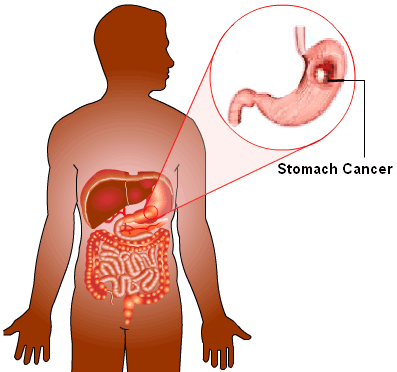 |
| Gastric Cancer Picture |
Everyone always talks about smoking related diseases like lung cancer, COPD and hypertension. But smoking is related to tons of other diseases, like gastric cancer. The thinking is that carcinogens are ingested during the smoking process and contaminate or affect the GI tract. However, many believe that there is no relationship between the two. That gastric cancer is just "tough luck" for those who acquire it. But as usual, those people would be wrong.
A recent study from Cancer Causes and Control (CCC) tells us that current cigarette smokers actually do have an elevated hazard ratio for gastric cancer over their never smoker counterparts, in both men and women. This is also true across ethnic groups. The researchers looked at African-Americans, Japanese Americans, Latino Americans, Native Hawaiians, and caucasions. Former smokers also had a higher risk than did never smokers, but only in men. The risk was also higher in those with a larger pack year history of smoking (packs per day x years smoked).
So there you go, yet another smoking related disease uncovered. It still amazes me why someone would want to start smoking in the first place. The perceived idea behind initiation is always trumped by the later acquired disease patterns and risks.
Auricular Therapy for Smoking Cessation
On this blog, we like to bring the latest scientific information to the reader with respect to smoking cessation. Sometimes, we even learn something along the way. Such is the case of a novel treatment idea called auricular therapy or auriculotherapy as it is also known. Yeah, we hadn't heard of it either. But I'm sure there will be con artists trying to sell this type of therapy to unsuspecting smokers, hoping to make a quick buck or two.
What is auricular therapy? Good question. This therapy involves the delivery of electrical pulses to specific points on the outer ear. Now, why anyone would think this would help people quit smoking in the first place, is beyond me. It probably came about as an extention of acupuncture. But regardless of how this connection came about, it is out there as a possibility for people who are desperately looking for a way to quit smoking.
Some researchers looked to see if there was anything to this therapy for smokers. They published their findings in the Journal of Addictive Diseases recently. So did this therapy help? Nope, not one bit. The nicotine dependence scores were the same for smokers in the control group and those who received the electrical pulses. Abstinence rates were also the same for both groups, reported as "low".
So if you ever hear people talking about auricular therapy for smoking cessation, then you can tell them not to waste their time or money. Better yet, send them over to our website where they can learn about a quitting smoking timeline, health benefits of cessation, and even learn how to develop a quit smoking plan. Sorry for the shameless plug.
What is auricular therapy? Good question. This therapy involves the delivery of electrical pulses to specific points on the outer ear. Now, why anyone would think this would help people quit smoking in the first place, is beyond me. It probably came about as an extention of acupuncture. But regardless of how this connection came about, it is out there as a possibility for people who are desperately looking for a way to quit smoking.
Some researchers looked to see if there was anything to this therapy for smokers. They published their findings in the Journal of Addictive Diseases recently. So did this therapy help? Nope, not one bit. The nicotine dependence scores were the same for smokers in the control group and those who received the electrical pulses. Abstinence rates were also the same for both groups, reported as "low".
So if you ever hear people talking about auricular therapy for smoking cessation, then you can tell them not to waste their time or money. Better yet, send them over to our website where they can learn about a quitting smoking timeline, health benefits of cessation, and even learn how to develop a quit smoking plan. Sorry for the shameless plug.
Subscribe to:
Posts (Atom)